Regional Competitiveness Plan:
WHAT IS IT?
For the purposes of this plan, the region includes nine Kentucky counties: Bourbon, Clark, Fayette, Franklin, Jessamine, Madison, Montgomery, Scott, and Woodford. Faced with a rapidly changing competitive landscape, the organization brought together a group of key regional stakeholders, and the consulting team from Economic Leadership, to create actionable intelligence about the region’s current economy and actions to improve future competitiveness. The goal was not to create an extensive work plan with dozens of action items for all the organizations involved. It was to identify a limited number of new efforts that would be impactful, provide benefit to the whole region, be financially feasible, and have the broad support needed from key regional public and private leaders to be successfully implemented.
For the purposes of this plan, the region includes nine Kentucky counties: Bourbon, Clark, Fayette, Franklin, Jessamine, Madison, Montgomery, Scott, and Woodford. Faced with a rapidly changing competitive landscape, the organization brought together a group of key regional stakeholders, and the consulting team from Economic Leadership, to create actionable intelligence about the region’s current economy and actions to improve future competitiveness. The goal was not to create an extensive work plan with dozens of action items for all the organizations involved. It was to identify a limited number of new efforts that would be impactful, provide benefit to the whole region, be financially feasible, and have the broad support needed from key regional public and private leaders to be successfully implemented.
Past Regional Plan Materials:
Regional Competitiveness Plan (Summary)
Regional Competitiveness Plan (Full document)
Regional Summit Briefing Booklet
Regional Leadership Council Meeting Booklet (March 29, 2023)
Regional Leadership Council Meeting Booklet (August 30, 2023)
Regional Competitiveness Plan (Summary)
Regional Competitiveness Plan (Full document)
Regional Summit Briefing Booklet
Regional Leadership Council Meeting Booklet (March 29, 2023)
Regional Leadership Council Meeting Booklet (August 30, 2023)
7 TAKEAWAYS FOR A MORE COMPETITIVE REGION:
#1 The regional economy needs to be more competitive.
Despite labor shortages, excellent educational attainment numbers and an outstanding quality of life, the regional growth in population, jobs, wages, and GDP lags many competitor communities and national averages. Aggressive actions and investments to improve the region’s competitiveness are needed. Without action the region will continue to lag.
#2 The regional labor force needs to grow.
The availability of skilled workers will be a critical factor in economic success in the coming years – probably the most important factor. The region’s labor force growth has been slow, and a better strategy for talent attraction and retention of younger workers is needed. Housing affordability is critical and Fayette County’s average home value has increased 57% between 2016-2021 and an additional 13% so far in 2022.
#3 More ready sites & buildings are needed.
The investment decision process has accelerated in recent years. For most clients, the immediate availability of shovel-ready sites, or ready-to-occupy buildings that meet their needs, is a determining factor. Due to infrastructure needs, zoning decisions, and the lack of speculative building the region’s real estate product is limited. Actions to expand and improve the available buildings and sites are needed to successfully compete for the opportunities that the region gets.
#4 Regional wages need to rise.
The region’s current industry mix creates too few high paying jobs. Actions are needed to focus marketing and business support efforts on industries that raise the average wages across the region.
#5 Opportunities abound.
As the impacts of the pandemic wane, reshoring expands and innovation surges, most businesses report a need for new facilities and more workers. In addition, federal stimulus funding is available to cities and counties to invest in infrastructure, product development and worker training. Kentucky and our region have opportunities to grow the advanced manufacturing, business services, and technology sectors, if they can meet business needs.
#6 Data analytics are important, and mostly regional.
Counties in the region are working to grow and improve, and these efforts are important. Detailed data is easily accessible to any potential investor today and “regional” is the geography most often used for comparison. Labor sheds, housing availability, cost of doing business and many other factors are aggregated at the regional level by site selectors and compared to other regions across the country. Regional assessment, collaboration and alignment is imperative to success.
#7 Regional collaboration can be hard, but it is necessary for success.
Branding, economic development marketing, talent attraction and retention, product development, and business support are all activities where working together can improve efficiency and effectiveness.
#1 The regional economy needs to be more competitive.
Despite labor shortages, excellent educational attainment numbers and an outstanding quality of life, the regional growth in population, jobs, wages, and GDP lags many competitor communities and national averages. Aggressive actions and investments to improve the region’s competitiveness are needed. Without action the region will continue to lag.
#2 The regional labor force needs to grow.
The availability of skilled workers will be a critical factor in economic success in the coming years – probably the most important factor. The region’s labor force growth has been slow, and a better strategy for talent attraction and retention of younger workers is needed. Housing affordability is critical and Fayette County’s average home value has increased 57% between 2016-2021 and an additional 13% so far in 2022.
#3 More ready sites & buildings are needed.
The investment decision process has accelerated in recent years. For most clients, the immediate availability of shovel-ready sites, or ready-to-occupy buildings that meet their needs, is a determining factor. Due to infrastructure needs, zoning decisions, and the lack of speculative building the region’s real estate product is limited. Actions to expand and improve the available buildings and sites are needed to successfully compete for the opportunities that the region gets.
#4 Regional wages need to rise.
The region’s current industry mix creates too few high paying jobs. Actions are needed to focus marketing and business support efforts on industries that raise the average wages across the region.
#5 Opportunities abound.
As the impacts of the pandemic wane, reshoring expands and innovation surges, most businesses report a need for new facilities and more workers. In addition, federal stimulus funding is available to cities and counties to invest in infrastructure, product development and worker training. Kentucky and our region have opportunities to grow the advanced manufacturing, business services, and technology sectors, if they can meet business needs.
#6 Data analytics are important, and mostly regional.
Counties in the region are working to grow and improve, and these efforts are important. Detailed data is easily accessible to any potential investor today and “regional” is the geography most often used for comparison. Labor sheds, housing availability, cost of doing business and many other factors are aggregated at the regional level by site selectors and compared to other regions across the country. Regional assessment, collaboration and alignment is imperative to success.
#7 Regional collaboration can be hard, but it is necessary for success.
Branding, economic development marketing, talent attraction and retention, product development, and business support are all activities where working together can improve efficiency and effectiveness.
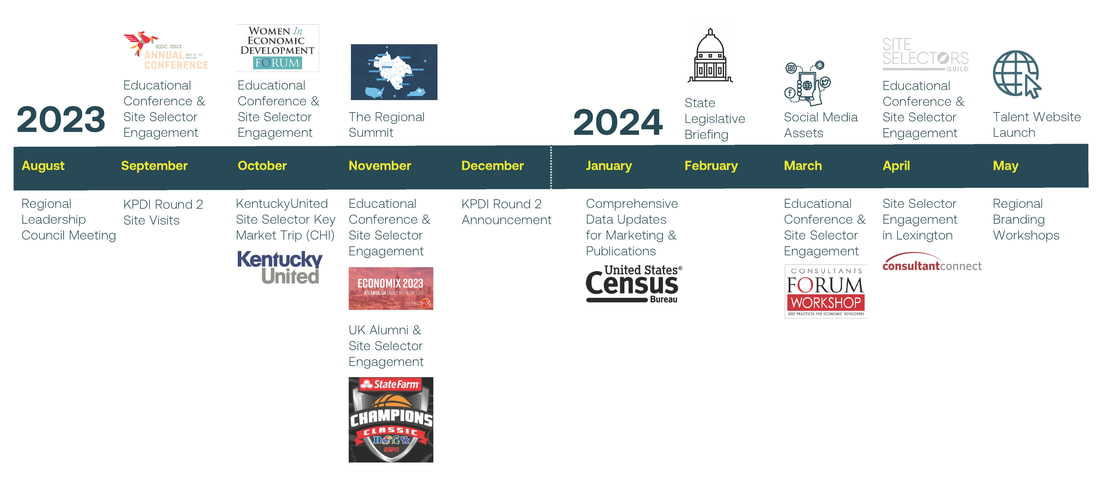
2023-24 REGIONAL PLAN TIMELINE: