
Delegation Advocates for Greater Lexington’s Federal Priorities During Washington, D.C. Fly-In7/18/2024
 Last week, 40 regional business and community leaders traveled to the nation’s capital for the annual Washington, D.C. Fly-In presented by Columbia Gas of Kentucky to act as policy ambassadors for the nine-county Bluegrass Region. During the July 9-11 visit, leaders from Greater LEX met with members of Kentucky’s Congressional Delegation and staff about priority issues to enhance regional competitiveness and policies that support the ongoing Regional Competitiveness Plan.
Greater Lex leaders engaged with U.S. Senate Republican Leader Mitch McConnell, U.S. Senator Rand Paul, U.S. Representative Andy Barr (KY-6), U.S. Representative James Comer (KY-1), U.S. Representative Brett Guthrie (KY-2), and U.S. Representative Morgan McGarvey (KY-3). Karen Kelly, chief of staff for U.S. Congressman Hal Rogers, briefed the group on behalf of the Congressman who was finalizing House appropriation bills. Given the leadership roles and key committee assignments (appropriations, energy and commerce, financial services, government oversight and transportation), Kentucky’s Congressional delegation is positioned to be highly influential and effective for Central Kentucky interests.
Commerce Lexington is proud to announce its recognition in the Business Facilities 2024 Economic Development Organization (EDO) Awards for its dedication to fostering public and private collaboration in support of Greater Lexington's first-ever Regional Competitiveness Plan. The Business Facilities EDO Awards celebrate economic developers' efforts in fostering community growth, securing record-breaking projects, and creating new economic opportunities. This year, Business Facilities editors evaluated entries from across the nation and selected 24 winners in various categories, acknowledging the tenacity and innovative spirit of these organizations.
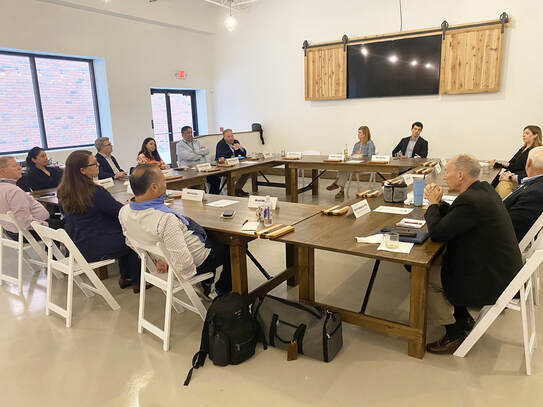 (Lexington, KY) – Commerce Lexington, the City of Lexington, and its regional economic development partners were proud to showcase the Greater Lexington Region during Consultant Connect’s Destination Summit held here from April 17-19. This premier event, sponsored by Commerce Lexington and the Lexington-Fayette Urban County Government, brought together top site selectors and local community leaders to discuss economic development opportunities and the competitive advantages of the Greater Lexington Region.
Consultant Connect is an organization that facilitates connections between economic developers and site selection consultants, offering opportunities for networking, learning, and relationship-building. The Destination Summits, organized by Consultant Connect, bring together top minds in economic development and site selection at various locations across the U.S. and Canada for intimate gatherings. These summits provide attendees with the chance to engage with location consultants, discuss industry trends, build relationships, and learn from experts in the field. Over the course of the three-day summit, attendees were immersed in the economic potential and cultural richness of Greater Lexington. The event boasted an impressive one-on-one ratio of attendees to location consultants, allowing for personalized and productive discussions about the region's competitive edge. The program featured discussions on the Regional Competitiveness Plan, updates on the Kentucky Product Development Initiative, and strategies from the developing talent campaign. 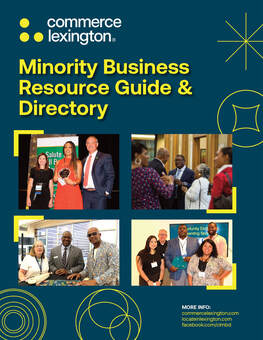 Commerce Lexington recently released its 2024 Minority Business Resource Guide & Directory, which not only aims to help area minority business owners find assistance to overcome challenges and barriers to their business, but also makes it easier for people and companies throughout our region to do business with Commerce Lexington member minority- and women-owned businesses. Commerce Lexington began publishing this Guide & Directory in 2007 when area business owners expressed difficulty in finding quality minority-owned businesses within the community.
Since the mid-1990’s, Commerce Lexington Inc. and its predecessor, the Greater Lexington Chamber of Commerce, along with its many partners throughout the community, have championed the efforts of minority-owned businesses. The Community & Minority Business Development (CMBD) program works to promote and sustain the economic growth, development and self-sufficiency of ethnic minority-owned business owners and entrepreneurs. Minority businesses are offered strategic and business planning, procurement assistance, access to lending tools, and the expertise of a full complement of economic professionals.  LEXINGTON, KY – The Greater Lexington region continues to be an attractive place for business and industry, according to Site Selection Magazine’s annual rankings of the top metros based on economic development activity. For 2023, the region achieved a significant move up the rankings in both total projects (10th) and projects per capita (7th), jumping into the Top 10 nationally for Tier 2 Metros with a population between 200,000 and one million.
Commerce Lexington’s Executive Vice President of Economic Development, Gina Greathouse, said, “We are very excited about this new recognition for the region. This success over the last few years is due in large part to the collaborative effort of many regional economic development partners who have worked together to attract new businesses and support the expansion efforts of many existing companies. This ranking reaffirms Greater Lexington’s position as a leading destination for business." |


Copyright © 2024 Commerce Lexington Inc., all rights reserved.
COMMERCE LEXINGTON® and the Commerce Lexington logo are registered trademarks of Commerce Lexington.
330 East Main Street, Suite 100, Lexington, Kentucky, 40507
Phone: (859) 254-4447
COMMERCE LEXINGTON® and the Commerce Lexington logo are registered trademarks of Commerce Lexington.
330 East Main Street, Suite 100, Lexington, Kentucky, 40507
Phone: (859) 254-4447